E: YZEIRA@SYR.EDU
T: 315-443-1749
Department of Political Science
Maxwell School of Citizenship
and Public Affairs
400F Eggers Hall
Syracuse, NY 13244
Yael Zeira
Associate Professor
of Political Science,
Syracuse University
I am an Associate Professor of Political Science at Syracuse University’s Maxwell School of Citizenship and Public Affairs and Director of its Middle Eastern Studies Program. In addition, I codirect the International and Intrastate Conflict Cluster in PARCC.
My research examines political conflict, ethnic politics, and ethnic violence, with a regional focus on the Middle East. In particular, I study the formation and evolution of political attitudes, group identities, and political behavior amid conflict and repression.
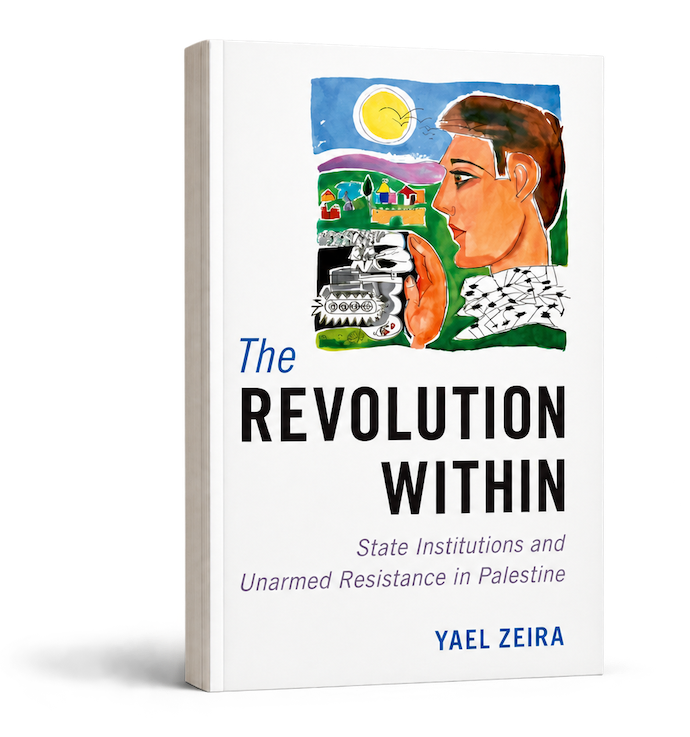
My first book, The Revolution Within: State Institutions and Unarmed Resistance in Palestine (Cambridge University Press) draws on extensive fieldwork in the Occupied Palestinian Territories to investigate how unarmed resistance against repressive regimes emerges in the absence of strong, autonomous civil society organizations and why individuals participate in its early stages, even without organizational support.
My current book project, co-authored with Alexandra Siegel, investigates how and why some civil conflicts become ethnicized and how such processes of ethnicization can be resisted or reversed. Using a new conceptual and methodological framework to measure ethnicization, the project analyzes variation in the salience of ethnic identity within and across contemporary conflicts in Syria, Yemen, Iraq, and Ukraine. It is supported by a two-year Distinguished Scholar Award from the Harry Frank Guggenheim Foundation.
My articles have appeared in the Proceedings of the National Academy of Sciences, Comparative Political Studies, the Journal of Conflict Resolution, and the Journal of Peace Research. I regularly teach courses on comparative politics, political conflict and violence, social movements, and Middle East politics.

The Revolution Within: State Institutions and Unarmed Resistance in Palestine
Despite having strong anti-regime sentiment, Palestinians initially lacked the internal organizational strength often seen as necessary for protest. This book provides a foundation for understanding participation and mobilization under these difficult conditions. It argues that, under these conditions, integration into state institutions – schools, prisons and courts – paradoxically makes individuals more likely to resist the state. Diverse evidence drawn from field research – including the first large-scale survey of participants and non-participants in Palestinian resistance, Arabic-language interviews, and archival sources – supports the argument. The book’s findings explain how anti-regime resistance can occur even without the strong civil society organizations typically seen as necessary for protest and, thus, suggest new avenues for supporting civil resistance movements.
BOOK DESCRIPTION
Anti-regime movements require mass participation to succeed. Yet, even in successful campaigns, most individuals do not participate. Why do some individuals participate in risky anti-regime resistance while others abstain? Under which conditions will anti-regime movements achieve broad participation? The Revolution Within answers these questions through an in-depth study of participation in unarmed resistance against Israeli rule in the Palestinian Territories over more than a decade.
-
This book provides a foundation for understanding participation and mobilization under these difficult conditions. It argues that, under these conditions, integration into state institutions – schools, prisons and courts – paradoxically makes individuals more likely to resist the state. Diverse evidence drawn from field research – including the first large-scale survey of participants and non-participants in Palestinian resistance, Arabic-language interviews, and archival sources – supports the argument. The book’s findings explain how anti-regime resistance can occur even without the strong civil society organizations typically seen as necessary for protest and, thus, suggest new avenues for supporting civil resistance movements.
The book is available in hardcover, paperback, and e-book from
Amazon and Cambridge University Press. You can also find the
introduction here.
Reviews
CURRENT BOOK PROJECT
Why Conflicts Become Ethnic
a book project with Alexandra Siegel
Fourate Chahal El Rebkaby
Ethnic conflict is often understood as violence between fixed ethnic groups, but constructivist perspectives emphasize that conflict itself can reshape and sharpen ethnic identities. This project develops a new framework for studying the ethnicization of conflict, which we define as a dynamic process through which ethnic identities become more salient and/or new ethnic identities are constructed in the context of conflict. We document when and to what extent ethnicization occurs, identify who and what drives it, and explain why conflicts follow different ethnic trajectories.
This project is supported by a two-year Distinguished Scholar Award from the Harry Frank Guggenheim Foundation.
Articles